
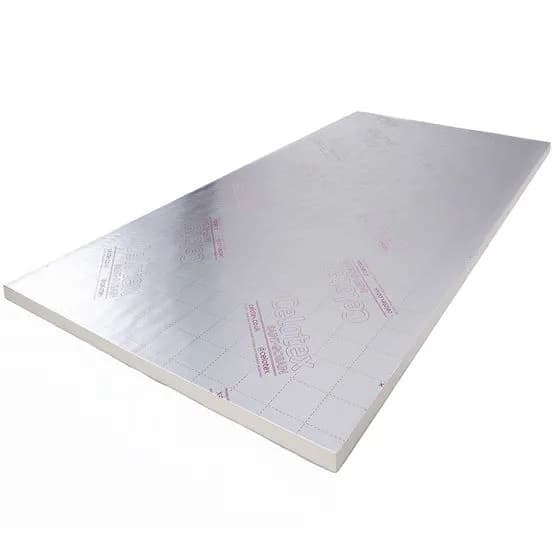
Celotex GA4000 Board
CelotexFeatured

Celotex GA4000 PIR Insulation Board

SKU: CX-GA4000-BASE

General purpose PIR insulation board.

Passivhaus CertifiedBBA CertifiedCE MarkedUKCA MarkedBest Seller
50mm: 50mm
£32.00inc. VAT
£26.67 ex. VAT · 10 per pack
In Stock
1

Please check delivery availability to your postcode before adding to basket.

Delivery availability varies
Secure checkout

Celotex GA4000 PIR Insulation Board

Celotex GA4000 is a versatile general purpose insulation board for floors, walls and roofs. Manufactured from rigid polyisocyanurate (PIR) using a blend of blowing agents with zero ozone depletion potential.

Key Features

  • Excellent thermal performance with lambda value of 0.022 W/mK
  • Aluminum foil facing on both sides
  • Lightweight yet structurally robust
  • BBA certified and meets Building Regulations
  • Easy to cut with standard tools

Multi-Application Use

GA4000's versatility makes it suitable for a wide range of building applications. The foil facing provides a low-emissivity surface that adds to thermal performance and can act as a vapour control layer when joints are taped.

Applications Include:

  1. Pitched roofs - between and over rafters
  2. Flat roof warm deck systems
  3. Solid masonry and cavity walls
  4. Concrete and timber floors

Installation Tips

Cut GA4000 boards using a sharp knife or fine-toothed saw. Score deeply and snap for clean edges. Tape all joints with foil tape to create a continuous vapour barrier.

Technical Specifications

Lambda Value0.022 W/mKDeclared
FacingAluminum FoilBoth sides
Board Size2400 x 1200 mmLarge Format
Compressive Strength140 kPaAt 10%

Order today for fast delivery and competitive pricing on all Celotex products!
Frequently Asked Questions

Celotex GA4000 is a versatile general-purpose insulation suitable for: pitched roofs (between and over rafters), flat roofs, solid and cavity walls, and floors. Its foil facing provides a low-emissivity surface that adds to thermal performance and can act as a vapour control layer when joints are taped.
Celotex GA4000 and Kingspan Thermawall TW55/Thermafloor TF70 are comparable products. Both use PIR insulation with similar lambda values (0.022 W/mK). Performance is essentially equivalent. The choice often comes down to availability, pricing, and personal preference. Both are BBA certified and meet Building Regulations.
Standard delivery is 2-5 working days for most products. Express delivery (next day or 1-2 days) is available for orders placed before 2pm on selected products. Large orders or specialist items may require additional lead time. Delivery times are shown at checkout based on your location and product availability.
Unused products in original packaging can be returned within 30 days of delivery for a full refund. A restocking fee of 15% may apply to large orders. Custom-cut or special order items cannot be returned unless faulty. Contact our customer service team to arrange a return.
Yes, the majority of our insulation products carry BBA (British Board of Agrément) certification, which confirms they meet quality and performance standards. BBA certification numbers are listed in the product specifications. This certification is often required for building control approval.
Yes, most insulation boards can be easily cut on site using a sharp knife, handsaw, or specialized insulation cutting tools. For PIR and phenolic boards, score deeply with a sharp knife and snap. For mineral wool, use a long-bladed knife. Always wear appropriate PPE including dust mask and gloves when cutting insulation materials.
For new builds in the UK, Building Regulations (Part L) typically require: Floors - R-value of 4.0-4.5 m²K/W, Walls - R-value of 5.0-5.5 m²K/W, Roofs - R-value of 6.0-7.0 m²K/W. However, requirements vary by project type and location. Always consult with your building control officer or a qualified professional for specific requirements.
PIR (Polyisocyanurate) insulation has a higher thermal performance per unit thickness compared to EPS (Expanded Polystyrene). PIR typically achieves lambda values around 0.022 W/mK, while EPS is around 0.038 W/mK. This means PIR can achieve the same thermal performance with thinner boards, saving space. However, EPS is generally more cost-effective for less demanding applications.

Related Products